
Storms on Kaua‘i
Should You Travel to Kaua‘i in Fall of 2026?
The short answer is…no. Not while recovery efforts are ongoing.
The State , County and Tourism Authority are asking visitors to change their reservations and visit one of the other Hawaiian Islands. And we agree with this advice. As longtime Kaua‘i residents ourselves, we can tell you firsthand that the island needs to focus on getting back to some level of normalcy before we can put energy into hosting visitors. We hope that welcoming everyone back will happen sooner rather than later, but at least the months of September and October (2026) need to be considered recovery time.
We will continue to update this page, as well as our travel guide app, with any changes and news on when Kaua‘i will be ready for visitors again.
What Happened with Hurricanes on Kaua‘i?
Being in the tropics means there’s going to be tropical weather. It’s a big part of why the Hawaiian Islands are so lush. The summer and fall months bring hurricane season (June–November), while the winter and spring months have the potential to produce lots of rainy weather, minus the cyclones. Though direct hits/landfalls are few and far between (see more about that below), 2026 has been a very active year of hurricanes in the Pacific Ocean.
There have been several major hurricanes that have threatened the Hawaiian Islands so far in 2026. Two have come close enough to cause major damage by way of strong winds, flooding and massive ocean swells.
Hurricane Lala passed the Hawaiian Islands in mid August of 2026, but not before causing lots of flooding and wind damage across the state. (The storm dropped enough rain to fill 1.9 million Olympic-sized swimming pools!) The eye of the storm “brushed” past the southern tip of Big Island as a Category 1 hurricane, with winds around 80 mph. Many areas, particularly the communities around South Point on the Big Island, saw wind damage and flooding that have a lot of recovery ahead of them.
If you’d like to donate to the recovery from Hurricane Lala, a list of legitimate charities has been put together by the local publication Civil Beat.
Hurricane Lowell stayed to the south of the islands, but made a sharp turn to the north toward Kaua‘i and Ni‘ihau. Overnight on September 7th, the Category 2 storm came within 40 miles of the islands. The island of Kaua‘i saw the worst effects from the hurricane and will be in recovery mode for the foreseeable future. (Reports from Ni‘ihau are still coming in, but it seems most the population evacuated to Kaua‘i prior to the arrival of the storm.) Many residents spent days without power or water, and damage to buildings, homes and roads across the south and west shores was extensive.
Donations for the recovery from Hurricane Lowell are much needed. Civil Beat organized a list of legitimate charities where your donations will make the biggest impact.
Hurricanes in Hawai‘i
Hurricanes tend to be few and far between here. Though 2026 has been a very active hurricane season (due in part to El Niño conditions), no hurricane has made landfall in the Hawaiian Islands for over 30 years. Hurricanes and tropical storms are so big, however, that landfall isn’t needed to cause devastation. Winds, heavy rains that lead to flooding and landslides, as well as huge surf can all still affect the islands even when the core of the storm is well offshore.
The last hurricane that slammed the islands was Hurricane ‘Iniki in 1992. The only previous hurricanes to hit the state in the 20th century were ‘Iwa in 1982 and Dot in 1959. (We had a couple mild encounters this century but, with the exception of Lala in 2026, they were very minor.) When Isabella Bird traveled here in 1873, where she penned her excellent book, Six Months in the Sandwich Isles, she reported that “hurricanes are unknown in the islands,” which means that there hadn’t been one in living memory.
It’s not just good luck. Hawai‘i has two things that provide some protection against hurricanes. Look at the photo below from 2015.
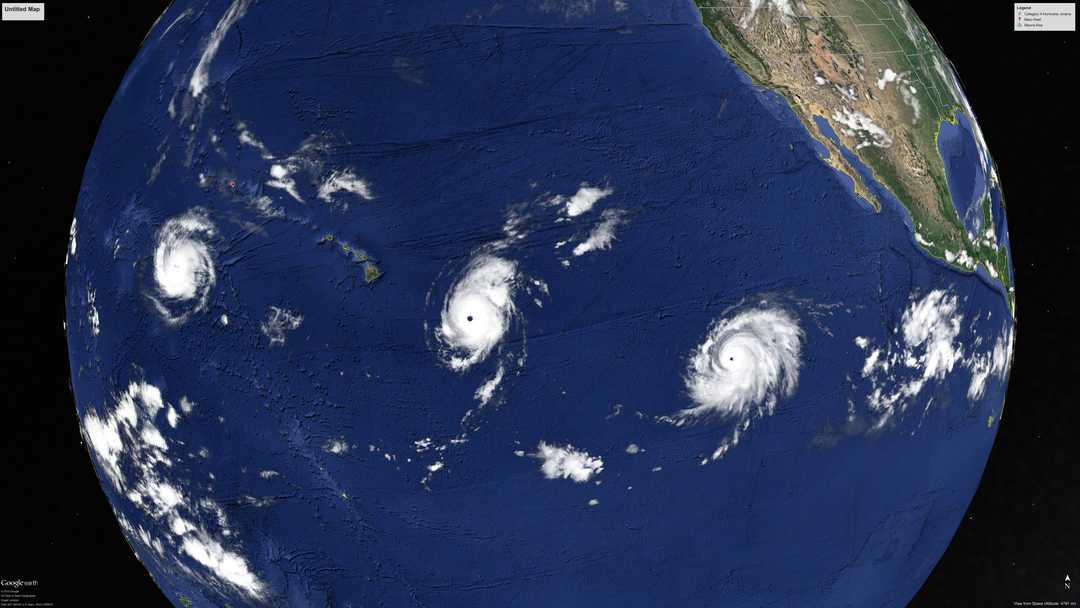
Pretty scary with the Hawaiian Islands located between two of those storms. But you didn’t hear about Hawai‘i getting slammed because we didn’t. Two of the things hurricanes need most are warm waters and height. When a storm makes a beeline straight toward the islands from the beginning is when we worry the least. As it leaves the warmer southern waters our relatively cooler waters usually act to weaken the storm.
And then there’s the height issue. Most flights to Hawai‘i take longer than the return flight. Every wonder why? You would think that our trade winds from east to west would make the planes fly faster. But airlines fly above 30,000 feet and those winds are usually from the west and strong. This wind shear has the affect of chopping the top off storms, weakening them.
So storms usually stay strong when they stay south of us and our usual high pressure system parked to the northeast of us usually repels the storms. (When ‘Iniki hit in 1992, the protective high pressure system moved away at the worst possible time and the storm, which had been to the south and strong took a right turn and flattened Kaua‘i.)