
When you think of iconic Hawaiian wildlife, what comes to mind? Green sea turtles (honu in Hawaiian), humpback whales (kohola), and maybe the Hawaiian goose (nene) are top choices for most casual visitors. (Heck, even the non-native day gecko often gets a shout out thanks to merchandizing going back to the 90s.) Monk seals aren’t necessarily as well known, but they are one of the only two endemic (meaning found nowhere else in the world) mammals in Hawai‘i. The Hawaiian Monk Seal has been in the news recently, so it seems like a good time educate everyone a little on what they are and get the word out on why these seals are special.
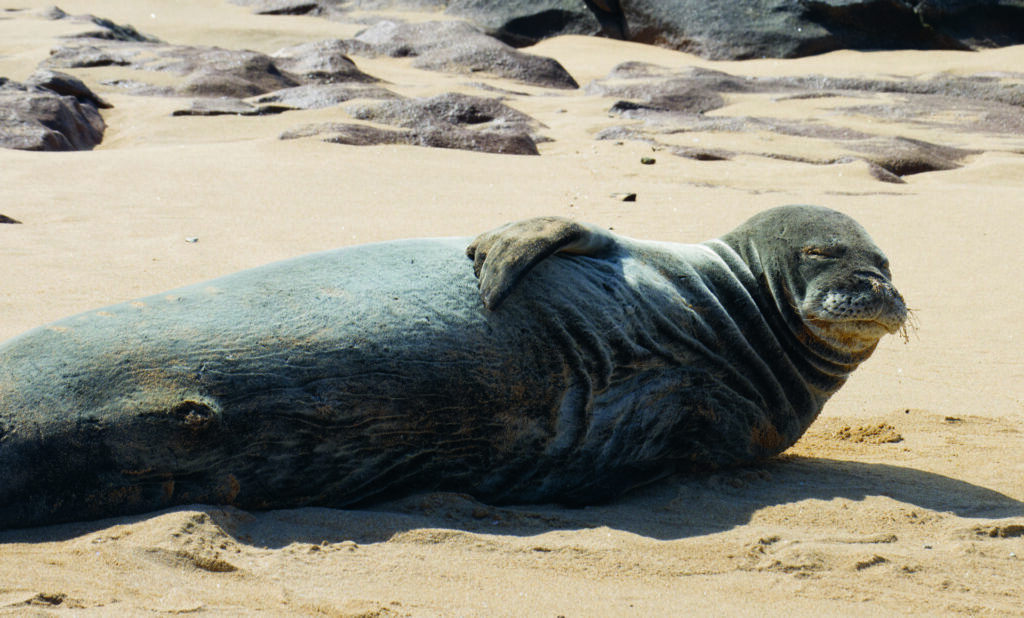
Who woke me up from my nap?
The Hawaiian name for the monk seal is ‘ilio holo i ka uaua, which means “dog that runs in rough water”. The ancient Polynesians that populated the Hawaiian Islands brought dogs with them, so when they saw these dog-like creatures cruising in the ocean they already had a word to describe it. The English term of “monk” seal comes from an 18th century naturalist that thought the dark fur on the backs of the seal, along with its rounded head, made them look like a monk wearing a hood—and coined the genus name “Monachus”, which is Latin for monk.
What modern taxonomy, comparative biology and genetics has taught us is that these seals are unlike almost any other found on the planet. While they are part of the larger family of seals that do not have external ears, they are considered relatively “primitive”, having been isolated for eons. The monk seals are the only seals that live in tropical or sub-tropical waters, and are relatively solitary compared to their cold water cousins. There are only three known species—one found in the Mediterranean, an extinct species from the Caribbean, and the Hawaiian species. Both the Mediterranean and Hawaiian monk seals are some of the most endangered marine mammals in the world.
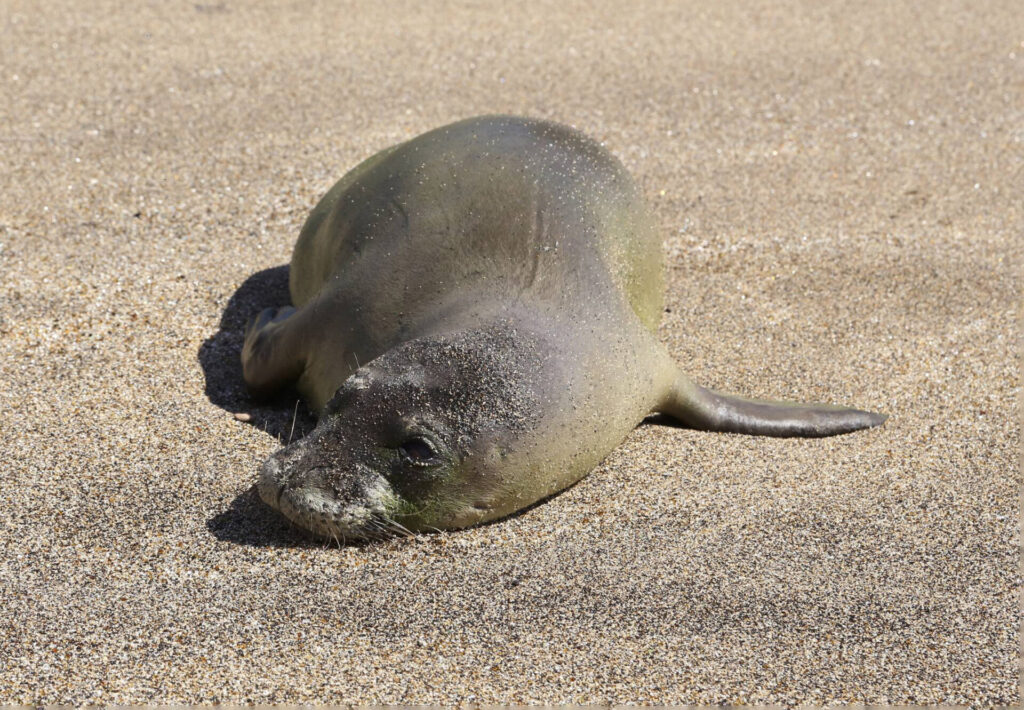
The Hawaiian monk seal is a generalist when it comes to diet. They eat fish, crabs, squid; most anything they can catch that’s small enough to fit in their mouth. They’ll grow to around seven feet long and weigh around 600 pounds, with a lifespan of up to 30 years. They spend around two-thirds of their lives in the ocean, but will come to shore and rest, sometimes for days at a time. They stick pretty close to shore when they give birth, too. Mothers tend to have their pups around March and April, but babies have been recorded throughout the year. Note that mothers are very protective of their young, and every few years people that get too close to the pups have been bitten.
The Hawaiian monk seal population is estimated to be only around 1,600. The majority of the seals live in the northwestern Hawaiian Islands, which is a marine preserve. Around 400 seals frequent the main Hawaiian Islands, and many of those frequent the same stretches of coastline. One of the biggest threats these seals face is entanglement from things like derelict fishing gear and ghost nets. This sometimes extends to bad interactions with the fishing industry, where seals are seen as competing for the same fish that humans go for. (They aren’t known to go for the larger game fish that many prize, but this same sentiment is seen in other parts of the world with dolphins.) Dog attacks are also a problem, especially for younger monk seals, and a good reason to follow leash laws. An unexpected threat even comes from one of Hawai‘i’s worst invasive species—cats. Cats spread a disease called toxoplasmosis that comes from a parasite that uses rats, mice and cats in its lifecycle. This nasty disease is a problem for all kinds animal life, as well as humans. It’s one of the leading causes of death in the Hawaiian monk seal.
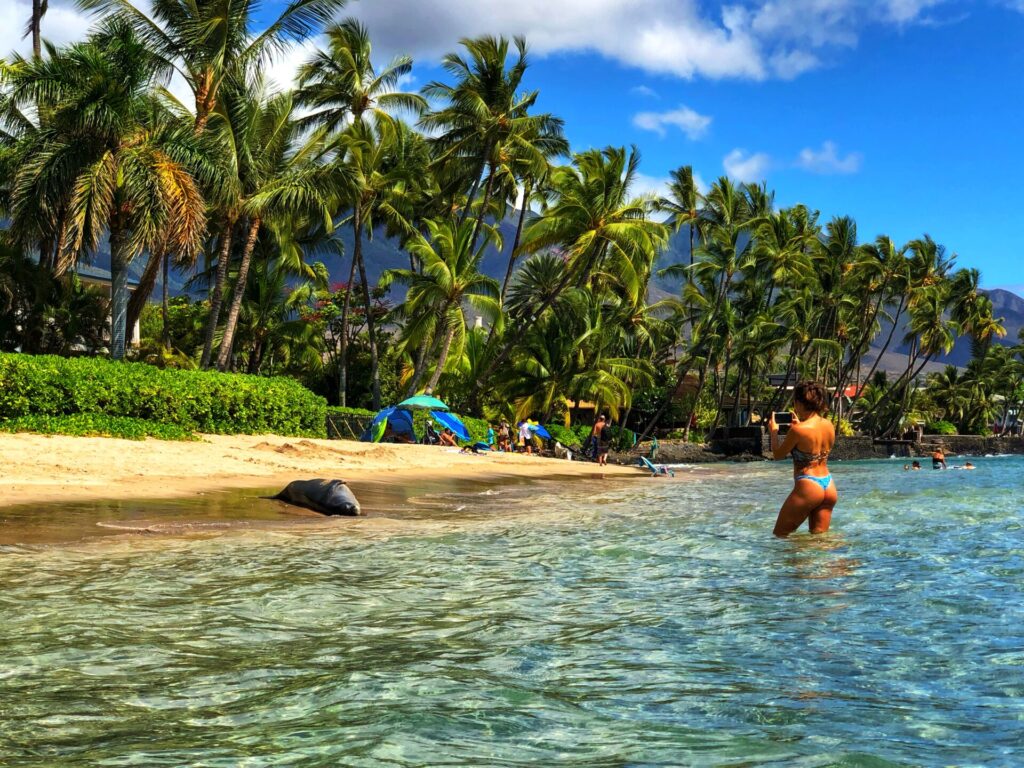
That’s too close to a monk seal.
With such a low population and only an increasing number of threats, the Hawaiian monk seal was placed on the endangered species list. They are protected federally by the Endangered Species Act and the Marine Mammal Protection Act, as well as state law in Hawai‘i. This means if you’re lucky enough to see one resting on the beach or swimming in the water, you need to give it space. By law, you need to keep at least 50 feet between you and the seal.
You can help with Hawaiian monk seal protection and recovery efforts by reporting all monk seal sightings to the NOAA Marine Wildlife Hotline at (888) 256-9840. If you see a monk seal (or any marine wildlife in Hawai‘i) in distress, call the same number and report it.
If you want to learn more about the Hawaiian monk seal, here are some great resources:
0 Comments